


Table of Contents


Ready to create more pipeline?
Get a demo and discover why thousands of SDR and Sales teams trust LeadIQ to help them build pipeline confidently.

.png)

AI agent data quality is the part most qualification agents can't check themselves, even though they're excellent at scoring fit
B2B contact data decays at roughly 22.5% a year, mostly because people change roles and companies, not because records go stale on their own.
The teams getting the most out of qualification agents pair the agent's reasoning with verified, sourced contact data delivered inside the same workflow, not as a separate step after the fact.
Get a demo and discover why thousands of SDR and Sales teams trust LeadIQ to help them build pipeline confidently.
Sales teams have started handing lead research over to AI. An agent picks up a new lead, checks it against the ideal customer profile, drafts a first outreach note, and hands the seller a fit score before anyone on the team has even looked at the record. It's a genuinely useful shift. 80% of enterprise applications now embed at least one AI agent, up from just 33% in 2024, and SDR-style agents show the fastest returns of any function, with a median payback of 3.4 months.
But there's a quieter problem sitting underneath all that speed, and it's one most teams don't notice until a rep is already on the phone: AI agent data quality. The agent's research is only as good as the contact record it's working from, and B2B contact data doesn't hold still. It decays.
An AI qualification agent is genuinely good at synthesis. Feed it firmographic data, behavioral signals, and a scoring model, and it will tell you, correctly, that a lead fits your ideal customer profile and is worth pursuing. What it usually can't tell you is whether the email address sitting in that lead record still belongs to a person who works there.
That distinction matters more than it sounds like it should. B2B contact data decays at an average rate of roughly 22.5% a year, and the underlying causes are almost entirely about people moving, not data going stale on its own. Around 70.8% of business contacts see some kind of change (title, company, or contact details) within a 12-month window, and close to 43% of phone numbers on file go bad over the same period. An agent scoring a lead as high-fit doesn't know any of that. It's reasoning over whatever sits in the CRM, and if that email bounced eight months ago, the fit score and the contact info are now telling two completely different stories.
Poor CRM data isn't a minor inconvenience either. Estimates put the cost of poor data quality to US businesses at around $3.1 trillion annually, and a Validity survey of more than 1,200 CRM users found 44% of companies estimate they lose over 10% of annual revenue to poor data quality. An AI agent that qualifies a lead beautifully but hands a rep a dead email hasn't actually saved anyone time. It's just moved the wasted effort one step downstream, from research to outreach.
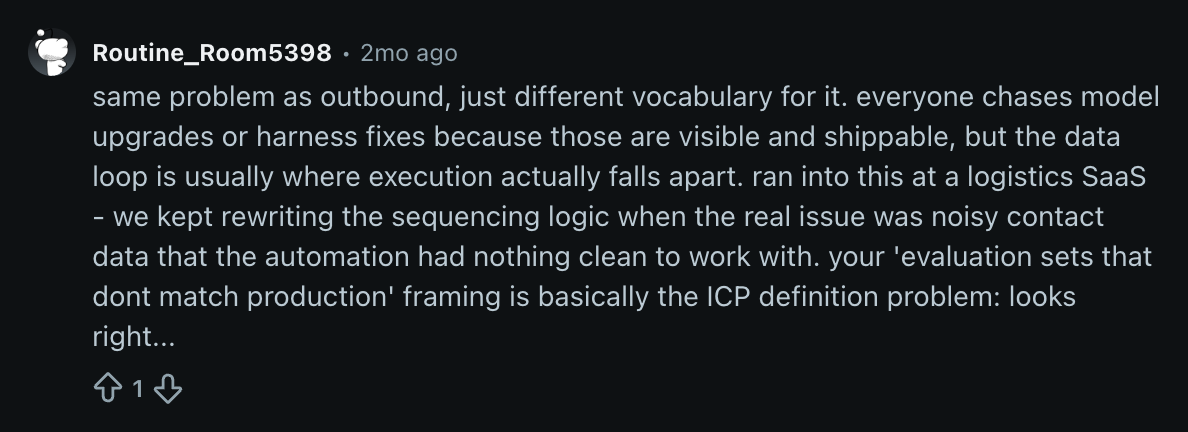
In a recent r/AI_Agents discussion on what actually determines agent execution quality, practitioners described the same failure pattern from the ground up: teams keep tuning model or sequencing logic when the real issue is noisy, unrepresentative data feeding the agent, since a bad input tends to produce a confident wrong answer instead of a visible error. As one engineer put it, describing a logistics deployment, "the data loop is usually where execution actually falls apart".
This gap has become more visible as qualification agents have gotten better at the reasoning part of the job. Microsoft's Sales Qualification Agent inside Dynamics 365 Sales, for example, autonomously researches a lead, checks it against a target customer profile, and can even draft or send an initial outreach email in its research-and-engage mode.
What none of that changes is where the underlying contact data comes from. An agent that's excellent at research still needs a source of truth for the two things that actually determine whether outreach lands: a working email address and a working phone number. Without that, the most sophisticated qualification logic in the world is still operating on a guess.
This is exactly the seam where verified, sourced contact data earns its keep, not as a separate research step bolted onto the workflow, but as an input the agent calls on the moment it needs it, the same way it already calls on firmographic or behavioral signals.
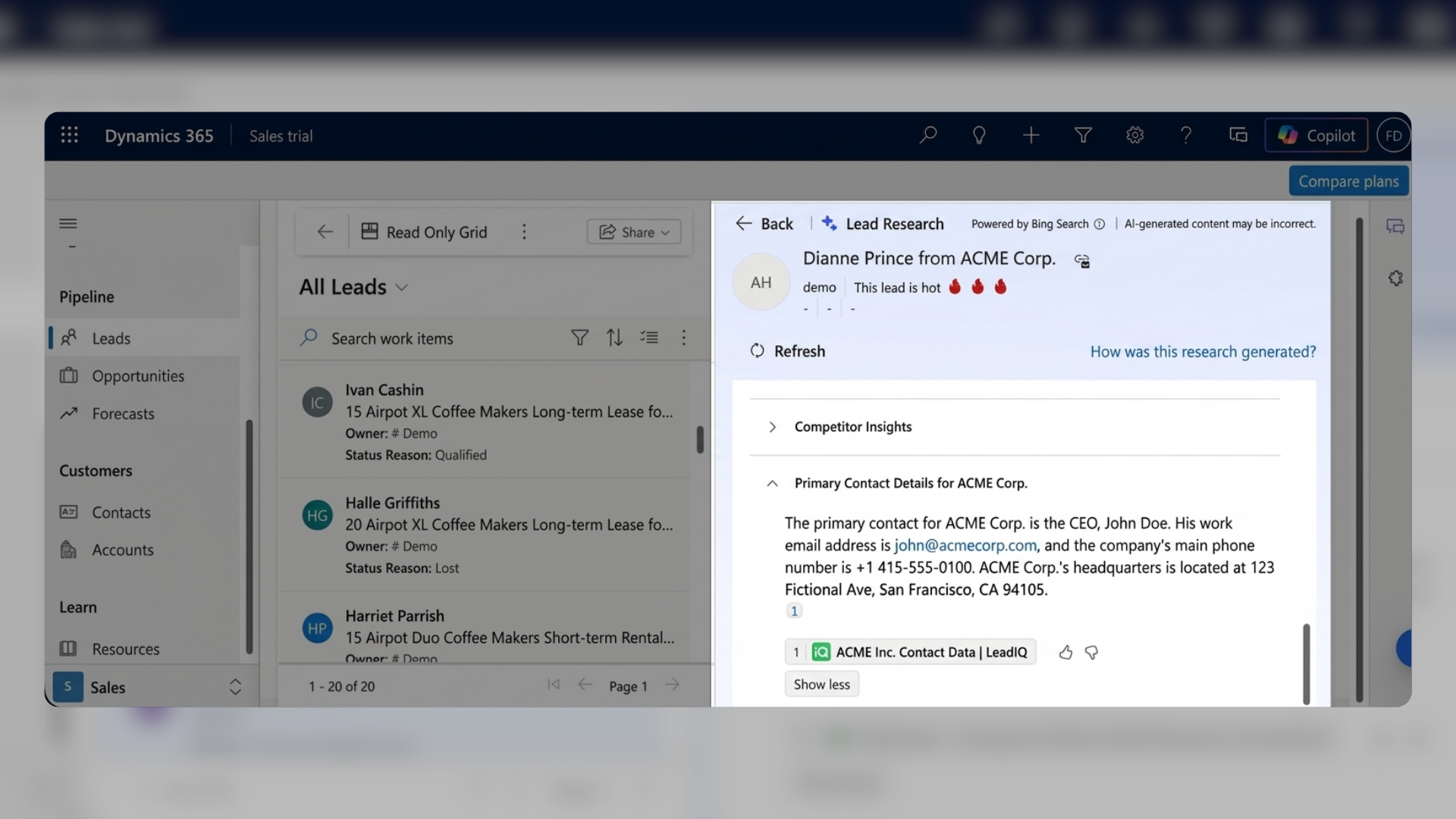
A handful of things separate a genuinely useful integration here from a checkbox feature:
- The verification has to happen inside the agent's existing research pass, not as a follow-up task a seller has to remember to run.
- The result needs to be visible where the seller already looks, not buried in a separate tool or tab.
- Every returned contact detail should be cited and sourced, so a seller can tell where a number or email actually came from.
- It has to be ready before the seller opens the record, noting with verified, sourced contact data delivered inside the same workflow, not as a separate step after the fact.
LeadIQ now connects directly into Dynamics 365's Sales Qualification Agent as a verified data source. Learn more about LeadIQ MCP inside Dynamics 365.
.png)
.png)
.png)